Appreciating Our Fourth Italian Christmas
“Sì, mi piacerebbe un po’ più di lasagna al pesce. Grazie!”
(“Yes, I’d love a little more fish lasagna. Thank you!” I said.)
I meant it with my whole heart—and my whole soul.
Patrizia’s Christmas fish lasagna, layered with delicate pasta, creamy béchamel, and generous bites of cozze (mussels)—one of my lifelong favorites—was nothing short of extraordinary.
In fact, it may have been the best lasagna I’ve ever eaten. And that’s saying something.
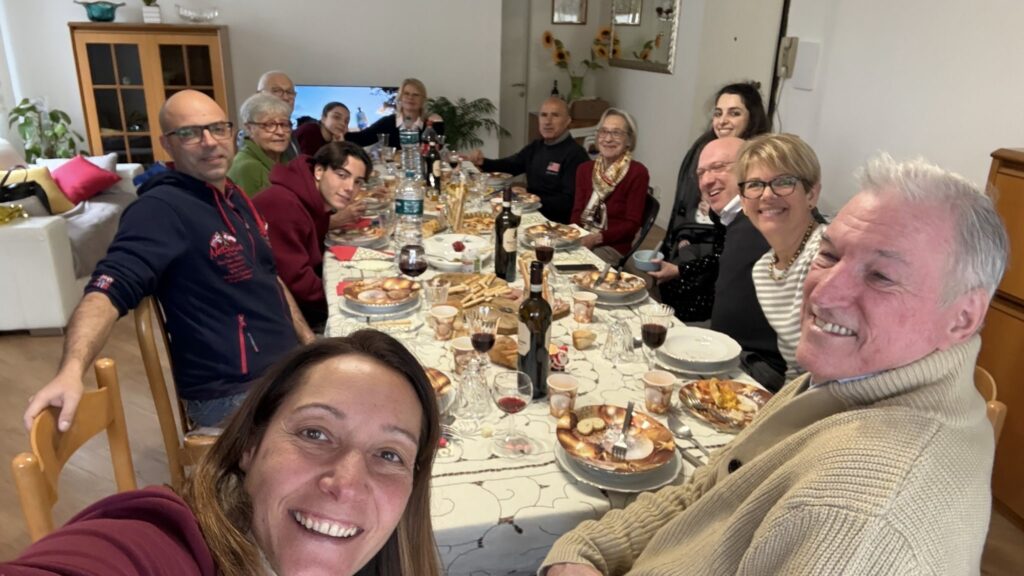
I was seated at the end of a long table, surrounded by fourteen smiling, laughing faces glowing with the unmistakable joy of Christmas.
This was il pranzo di Natale, Christmas lunch, in the home of Salvatore and Patrizia—parents of our dear friend Antonio. In true Italian fashion, the entire family was present.
Antonio’s wife Mary was there—Antonio and Mary were our very first friends in San Vincenzo, the couple who helped us buy our unfinished home within days of our first San Vincenzo visit, even though we were still living in Southern California at the time.
Read my article >>> “Coming to San Vincenzo”
Mary’s parents, Franca and Natale, joined us, along with Antonio and Mary’s children, extended family, and close friends.
At one point, Franca approached me, smiling warmly, her kind, gentle eyes meeting mine.
She said something like, “È un piacere darti il benvenuto nella nostra famiglia.” (“It’s a pleasure to welcome you into our family.”)
I may not have understood every word perfectly—but I didn’t need to. Her eyes said everything.
In that moment, I felt an overwhelming sense of belonging, moved by the warmth of a family we hadn’t even known five years earlier.
People here are greeted with hugs and kisses (both men and women) which is a nice display
of acceptance and love.
Sharing this six-hour, multi-course feast were people ranging from a six-month-old baby to grandparents in their seventies and eighties. Everything felt easy. Natural. Loving.
I realized how comfortable I had become—not only sitting at an Italian table for hours but listening to Italian conversation flow around me.
I still have much to learn, but I could finally understand most of what was said and even speak enough to (usually) “get by.” That realization alone felt like a Christmas gift.
Christmas in Italy: Family, Festivities, and Food
(And how it differs from America)
I’ve always loved Christmas, but living in Italy revealed something magical I never expected: Christmas here lasts a full month.
For someone like me, that discovery was pure joy.
The season officially begins on December 8, the Feast of the Immaculate Conception, a national holiday when decorations traditionally go up. It ends on January 6, Epiphany—twelve days after Christmas—when decorations are taken down.
(As with many Italian traditions, details vary widely by region.)
Throughout December, homes, piazzas (city squares), and streets glow with festive lights, stars, and decorations.
Yet two elements reign supreme in Italian Christmas culture:
1 – L’Albero di Natale – the Christmas tree
2 – Il Presepe – the Nativity scene
Nativity scenes here are an art form. From simple tabletop displays to elaborate city installations with moving parts, music, lighting, and even life-sized figures, they are everywhere.
One of my favorites is the beautifully detailed presepe displayed each year on San Vincenzo’s main Corso, in the window of the Farmacia (Pharmacy).
Italy is also famous for its Christmas markets, and my wife and I have visited many in northern Italy, where snowcapped Dolomites and Alpine peaks frame postcard-perfect villages.
These markets are wonderful places to find handmade ornaments, carved wooden figures, and nativity pieces that eventually make their way into Italian homes.
Each item carries the spirit of the place where it was made.
San Vincenzo itself comes alive at Christmas.
The Corso sparkles with lights, shops buzz with holiday energy, concerts fill the air, and caroling becomes part of daily life.
My wife sings in the city choir, which often travels to nearby towns to perform—another beautiful thread in the fabric of the season.
The Italian Christmas Table
Food, of course, is at the heart of everything.
The first major feast arrives on Christmas Eve—La Vigilia di Natale—traditionally centered on fish and
shared with family.
This year, we were invited to the home of a close friend, Guilherme (a Brazilian with dual Italian citizenship) to celebrate with his new girlfriend, Vanessa.
It was a remarkable evening.
Vanessa, who works in top management for a Brazilian winery and may soon move to Italy, prepared an inspired fusion feast: ricotta and seafood ravioli with Brazilian accents; bruschetta topped with Tuscan ham, arugula, ricotta, blackberry jelly, and Tartufo cheese. It was unforgettable.
Christmas Day, however, belongs to il pranzo di Natale—an enormous lunch with many courses, flowing wine, and hours of conversation.
Dessert is typically Panettone (from Milan) or Pandoro (from Verona), often served with espresso and something stronger afterward.
The day after Christmas, Santo Stefano, is another national holiday devoted to visiting friends
and—naturally—another feast (usually leftovers).
Then comes New Year’s Eve (La Vigilia di Capodanno), when Italians famously “eat their way to midnight.” Lentils are essential, symbolizing good luck and prosperity for the coming year, followed by music, fireworks, and celebration.
Back to That Christmas Lunch
By the time we reached dessert at Patrizia and Salvatore’s table, we had enjoyed an abundance of food:
spritz and tagliati to begin, followed by pizzoccheri, extraordinary local wines, two kinds of fish lasagna, sausage pie, pumpkin pie, cheese rolls with croutons, dessert, coffee, and grappa.
Wives and husbands moved effortlessly between kitchen and table, ensuring nothing—and no one—was ever lacking. Conversation flowed easily for more than six hours.
Teenagers, grandparents, friends, hosts, and guests all shared the same space with genuine joy.
There was no tension, no politics, no division—only laughter, stories, and warmth.
I smiled when I saw Antonio playing with the six-month-old baby, making silly faces and drawing smiles so pure they melted my heart.
As evening approached, Lynn and I finally said our goodbyes so we could call family back in America. We left full—of food, yes—but even more so of gratitude.
My wife and I usually spend New Year’s Eve quietly at home in our Tuscan villa—enjoying a leisurely dinner, excellent Tuscan wine, and most importantly enjoying each other!
Then, close to midnight, we slowly ascend to the upper balcony where we have an unobstructed view of the Etruscan coastline.
We each have a glass of the best Tuscan wine. Often, a full moon is out which bounces sparkling reflections off the distant sea.
This is my article >>> Discovering the Timeless Wines of Tuscany
The sky is always filled with endless stars. Then it happens… the steady progression of explosions booming colorful sprinkles of new year birth down the entire coastline.
It is amazing. It is magical. Even so, when I look into my wife’s eyes, I realize that nothing is more magical than the two of us existing together, in this wonderful land with such wonderful friends.
Leave a Reply